
Book Notes: The Definitive Drucker (Part 1)
What Construction Can Learn from Drucker's Management Principles

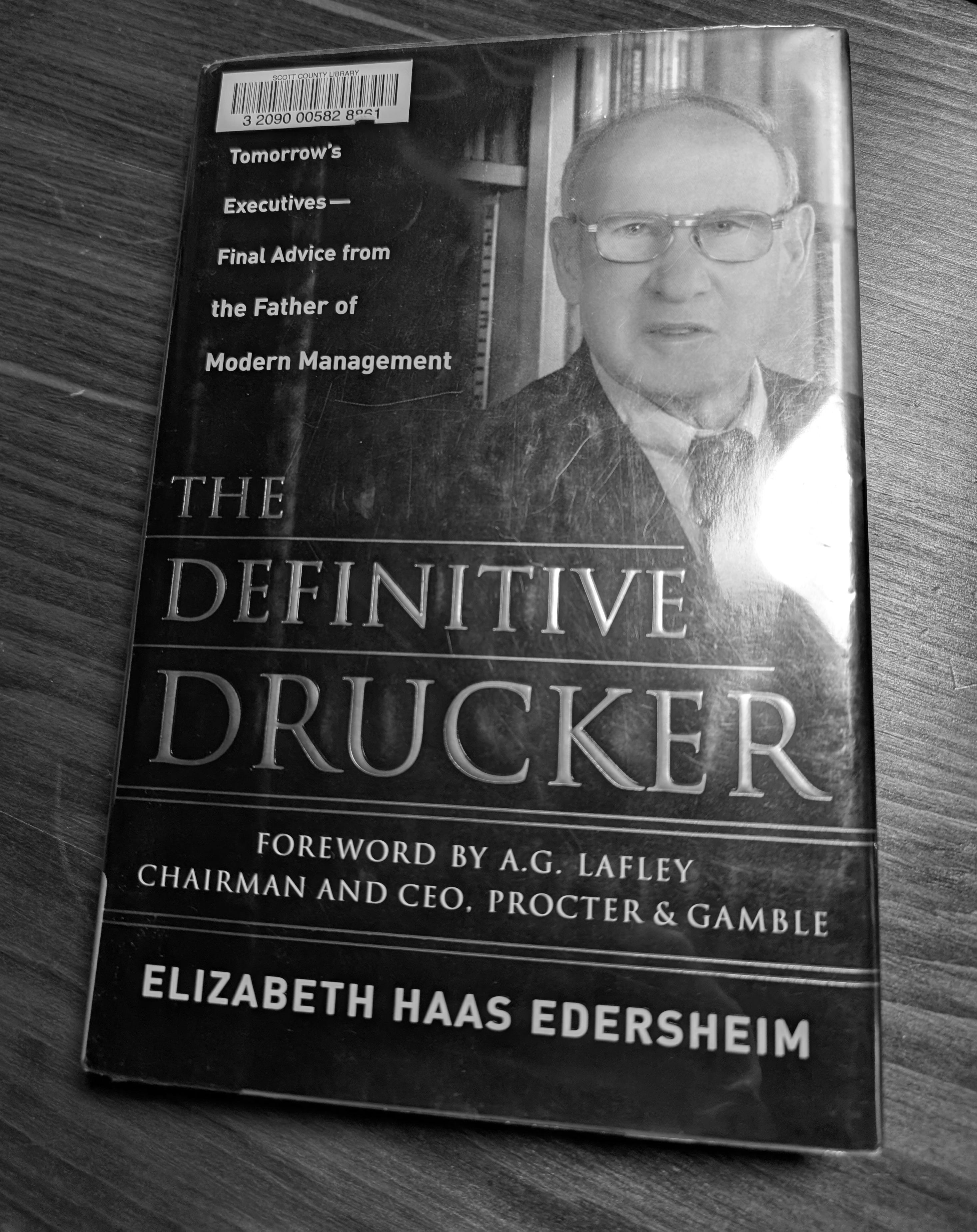
In Book Notes, I apply powerful ideas from business literature to solve real challenges in design and construction. Right now, I’m reading The Definitive Drucker, a biography of Drucker’s ideas by Elizabeth Haas Edersheim. Published in 2007, these ideas still apply to our industry.
I’ve heard from many teams in the past few years that “We don’t have time to plan. We need to focus on everything.” This perfectly captures our industry's strategic challenge - and it's exactly what Peter Drucker addressed decades ago when he wrote about the importance of making clear choices. In today's Book Notes, I'll show how Drucker's principles solve our modern construction dilemma of unfocused strategy.
ARTICLE OUTLINE:
INDUSTRY CHALLENGE: Our Strategies Lack Focus and the Ability to Evolve with New Information
KEY INSIGHT: Strategy Must Evolve With New Knowledge
IMPLEMENTATION STRATEGY: Adopting the Enhanced Definable Features of Work Framework
INDUSTRY CHALLENGE: Our Strategies Lack Focus and the Ability to Evolve with New Information
In design and construction, we mistake activity for strategy and progress. We are overwhelmed with endless tasks, meetings, and documentation, losing sight of what truly matters. Drucker noted this happens when we fail to decide where to focus our limited time and energy.
"He [Drucker] believed in the power of strategic ideas and making clear choices. He said, 'From quiet reflection will come even more effective action.’" (pg. x) (Note: The emphasis here is my own.)
In our industry context, reflection is planning, and action is execution - designing and building. Due to the pace of our projects, there’s little space for strategic reflection; for planning. The pressure to execute overrides the disciplined planning and critical thinking.
"We have to retool our schools so that students don't simply learn how to answer multiple choice questions. They need to synthesize information and think critically." (pg. 38)
Our teams need to do the same thing: think critically - plan the work- and synthesize information - put knowledge to work. Planning means choosing what to execute. We can't do it all, and not all tasks are of equal importance. Not all tasks make equal progress. Knowing how to make these decisions is what sets an individual or team apart.
Also, when new information presents itself as projects progress, teams struggle to process and organize it in a tactical way.
"We will not be limited by the information we have. We will be limited by our ability to process that information." (pg. 13)
This is what defines the industry's Lessons Learned problem: Organizations are unable to process lessons from prior work. We're too focused on how to process it, rather than learning from it. This is an example of motion without progress.
Knowledge is now more valuable than hard assets. Leveraging the Definable Feature of Work (DFOW) framework I've developed addresses this directly. (You can read more about this here.)
Let’s revisit the two problems with our modern understanding of a DFOW:
The specifications serve as the primary basis for the DFOW list.
The DFOW list is created after construction mobilization.
The first problem can be resolved by expanding our foundation of the DFOW to include:
Client Intent
High Risk / Critical Path Activities
Experience and Lessons Learned
Drawings and Specifications
By breaking projects into manageable components and identifying what matters most in each, teams can make clearer choices about where to focus. This establishes a common language for prioritization across all disciplines – design, construction, operations, development, and preconstruction.
Without this shared framework, teams in different disciplines focus on what they individually consider important, often leading to misalignment and rework later.
KEY INSIGHT: Strategy Must Evolve With New Knowledge
"A strategy is not a goal; it is a direction, a blueprint for putting the pieces together and building. It must have continuous feedback to translate real-time results into refinements and changes as appropriate." (pg. 40)
The construction industry has a problematic relationship with change. We see change as something to avoid or minimize rather than an opportunity to refine our approach based on new knowledge. This mindset stems from conflating physical changes to the building (which have cost implications) with strategic adjustments to how we manage the project.
As knowledge increases throughout the project lifecycle, our strategy should evolve accordingly. Strategy is focus, and it must change throughout the project because we only know what we know at that moment in time. Our knowledge increases as the project progresses, and that constant flow of new knowledge must be incorporated into the work.
The resistance to strategic adaptation comes from two industry problems:
We equate any change with change orders and additional costs
We lack mechanisms to systematically incorporate new knowledge into our approach
IMPLEMENTATION STRATEGY: Adopting the Enhanced Definable Features of Work Framework
The enhanced DFOW Framework includes:
Client Intent
High Risk / Critical Path Activities
Experience and Lessons Learned
Drawings and Specifications
Both design and construction teams should adopt the Definable Features of Work framework. This allows teams to prioritize the same elements and have a means for effective collaboration.
Review the list of Definable Features of Work weekly. Confirm that each DFOW on the list is still important. Remove DFOWs that are complete or no longer require special attention. Add DFOWs that, based on new information, now deserve additional focus and planning.
Organize your learnings (warranty spend, profit losses, incidents, schedule delays) by Definable Feature of Work. Projects are not unique, rather they are a collection of DFOWs, allowing learnings to be applied across projects. This is the foundation for effective knowledge transfer.
EXAMPLE: Design Reviews
A barrier to successful design reviews is the amount of information to process - how to synthesize it, and how to decide what to focus on. Designers will have a different idea for what’s important, as will construction. Without an objective means for deciding what elements of the project deserve more focus than others, each team will decide on their own in isolation. It is in these collaboration gaps where problems arise later in the project, creating costly changes.
Design teams can use the DFOW as part of the briefing for a design review or page turn. The list of DFOWs is a clear guide for reviewers, telling them where to focus their time, rather than trying to review everything (a page turn with no direction).
The design team takes responsibility for starting the list of DFOWs, specifically the Client Intent items. (A flaw with the traditional view of a Definable Feature of Work is its focus only on the Specifications and leveraged solely during the construction phase.)
In the design review kickoff meeting, discuss the list of the DFOWs while assigning subject matter experts to each, ensuring they are all covered.
Also, during handoffs to the construction team, the list of DFOWs becomes a starting point for construction during their early planning sessions. Design and construction disciplines often have different ideas of what’s important. Yet if each project phase used the same framework for quantifying risk and other critical project elements, we collaborate more effectively.
Teams have reported improved alignment on critical building elements when using this approach.
Coming Next
In the next installment, we'll explore Drucker's insights on understanding customer value, the changing nature of customer relationships, and how collaboration across organizational boundaries is transforming the industry.